
The Marie Skłodowska-Curie – Doctoral Network (MSCA – DN) 2026 call opened on 28 May 2026. The deadline for submitting proposals is 24 November 2026.
What is an MSCA Doctoral Networks project?
Doctoral training networks (MSCA DN) fund consortia comprising universities, research organisations and businesses that jointly recruit and train PhD students on projects with a strong scientific and cross-sectoral focus.
There are three possible project formats:
- Standard Doctoral Networks, for traditional academic and non-academic consortia.
- Industrial Doctorates, where the doctoral student is co-supervised by an academic partner and a non-academic partner (company, NGO, etc.).
- Joint Doctorates, which lead to a joint, dual or multiple doctoral degree awarded by several institutions.
For all projects, the priorities are international mobility, training in transferable skills (entrepreneurship, commercialisation, intellectual property management, scientific communication, etc.) and high-quality supervision, formalised through a career development plan for each PhD student.
What has changed compared with the 2025 call for applications
- A minimum threshold for each evaluation criterion: excellence, impact and implementation must each score at least 3/5, otherwise the proposal will be automatically rejected.
- Extended secondments: the option to spend up to 50 per cent of the contract period with another partner, compared with one-third previously (i.e. up to 18 months on a 36-month employment contract)
Greater flexibility regarding PhD enrolment for beneficiaries from third countries not associated with Horizon Europe. It is now possible to enrol their PhD students solely in their local PhD programme (unlike in previous calls, where PhD students were required to be enrolled at an institution in a Member State or associated country)
A brand-new, 100% AI-focused initiative: the RAISE Doctoral Networks for AI in Science pilot (€30 million) has been added to the standard call for consortia that are developing or integrating AI at the heart of their scientific programme. This is not a separate call. Proposals will be submitted via the standard DN 2026 call, with a one-page justification in section B2 to indicate interest in RAISE.
Why should you apply for this call for proposals?
With a budget exceeding €590 million, the MSCA Doctoral Network call for proposals remains one of Horizon Europe’s most attractive instruments for doctoral training. Beyond the funding, it also offers:
- a unique opportunity to establish or consolidate a network of European and international partners, both academic and non-academic;
- a powerful tool to attract high-calibre PhD students, with improved salary conditions;
- a means of enhancing scientific and institutional influence, thanks to the visibility and recognition afforded by the Marie Skłodowska-Curie label;
- a bridge to innovation and the socio-economic world, via Industrial Doctorates and the now-expanded cross-sectoral secondments.
But beware: competition remains fierce (an average success rate of 14% across all MSCA calls[1] and the new rules (thresholds per criterion, strict formatting requirements) leave less room for approximation. A well-structured application, right from the very first lines, makes all the difference.
Euronovia will help you put together your proposal!
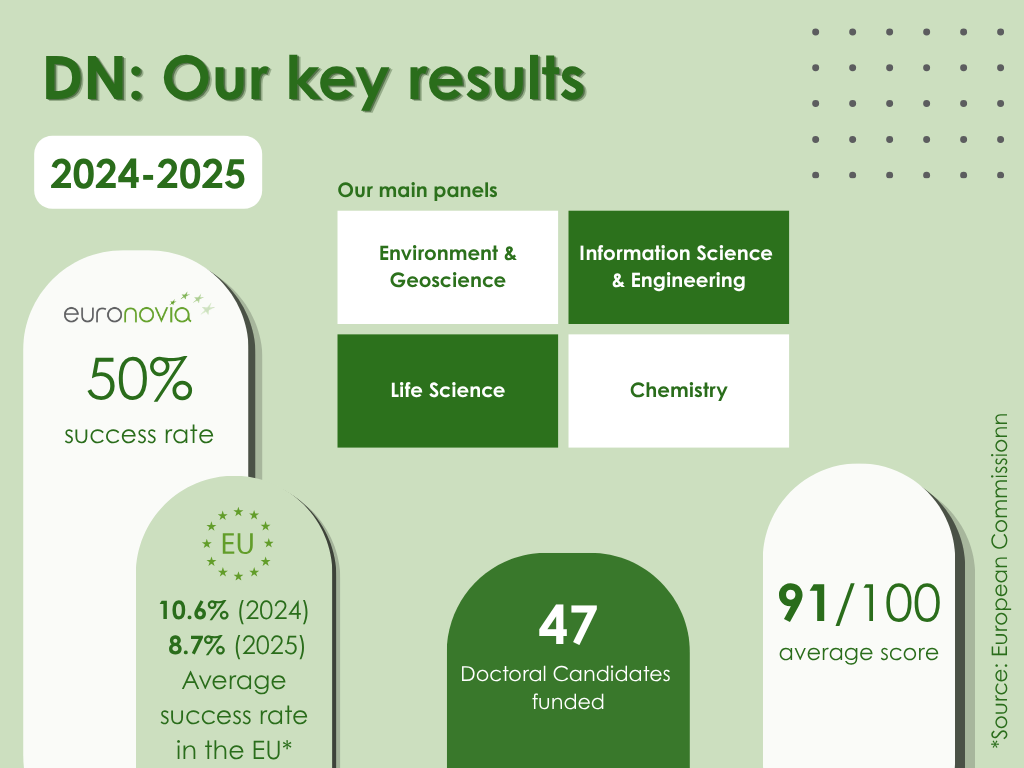
Setting up a European consortium, drafting a robust proposal and ensuring compliance with the latest requirements in terms of both form and content: it’s our job ! With a 50% success rate for 2024–2025, Euronovia supports researchers, universities and businesses in setting up their European projects, from structuring the consortium to the final proofreading of the application.
Do you have a project idea or a consortium currently being formed? Contact us at [email protected] to discuss it!
[1] https://eur-lex.europa.eu/legal-content/EN/TXT/PDF/?uri=CELEX:52026DC0255)